Last updated on October 6th, 2026 at 05:19 am
Why this guide matters to you
You’re thinking about a pram — maybe for a newborn, a growing family, or to make life easier on your daily outings. A pram is more than a buggy: it gives safe, flat space for infants and suits walks in parks, city pavements or public transport across the UK. This guide explains what a pram is and why it still matters to modern parenting in Britain.
You’ll find help to choose the right style for your life, whether you need an all-terrain for Lakes, a compact for London travel, or a budget option at UK hire and shops. By the end you’ll know where to buy, borrow or hire and what features matter.


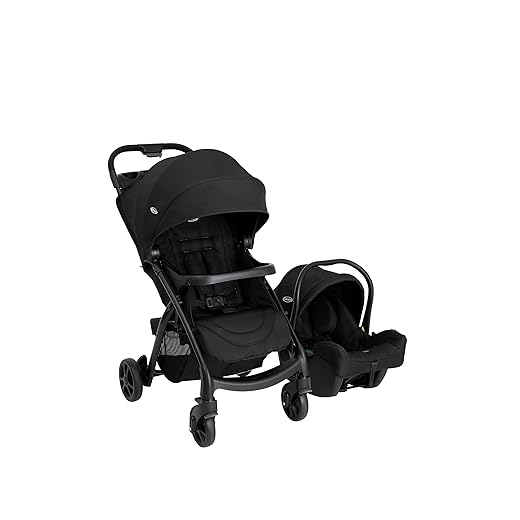

Stroller vs Pram: What’s the Real Difference?
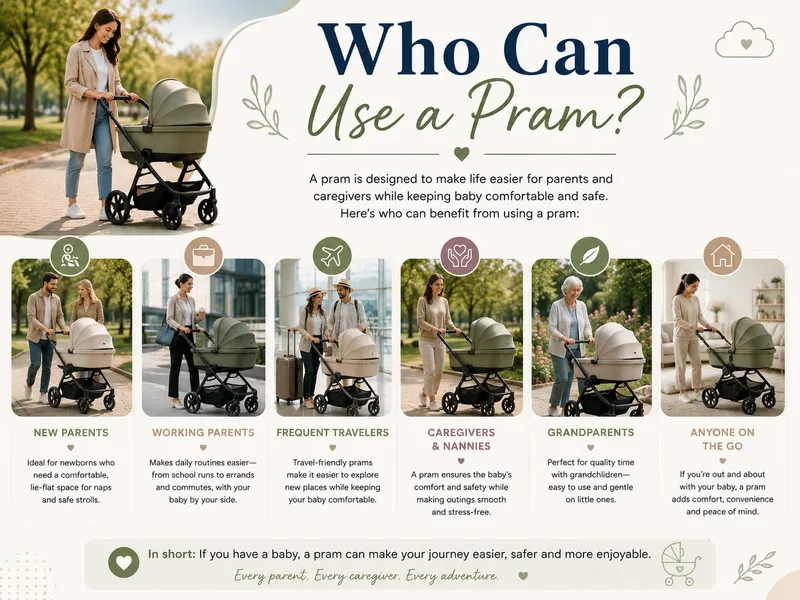
Who typically uses a pram (and why it might be right for you)
A pram isn’t just for first-time parents — it’s a practical tool that answers specific needs. Below are common user groups, real-life cues to help you decide, and quick tips so you can spot when a pram will make everyday life easier in the UK.
Newborn parents who need a flat lie
If your baby spends long periods sleeping and you want NHS-recommended flat sleep for the first months, a carrycot-style pram is essential. Look for a deep, well-ventilated cot with a firm base. Tip: test the flat lie in-store at John Lewis or Mamas & Papas to check access and ventilation.
Parents of twins or multiples
When two children need full-length lie-flat spaces, a tandem double or a twin pram saves backaches and tricky transfers. These models also often fold for car boots and have car-seat compatibility.
Carers, shoppers and commuters
If you’re juggling shopping, buggy bays on trains, or a pram that fits through London Underground gates, prioritise large storage baskets, easy folding, and lockable front wheels. Practical tip: measure your car boot and doorway before buying.
Toddlers who nap on long walks
For longer countryside rambles or playground-to-cafe days, a pram with a reclining seat and good suspension keeps toddlers comfortable and reduces mid-walk tantrums. Consider weight limits and sun/cold weather covers.
Grandparents, foster carers and split-household parents
You might need a robust, low-maintenance pram that’s easy to transfer between homes. Choose something durable, simple to fold, and available from nationwide retailers (Argos, Boots) for easy returns or replacement parts.
Quick cues: choose a pram over a pushchair or sling if:
Next, we’ll walk through pram styles so you can match features to these real-life needs.
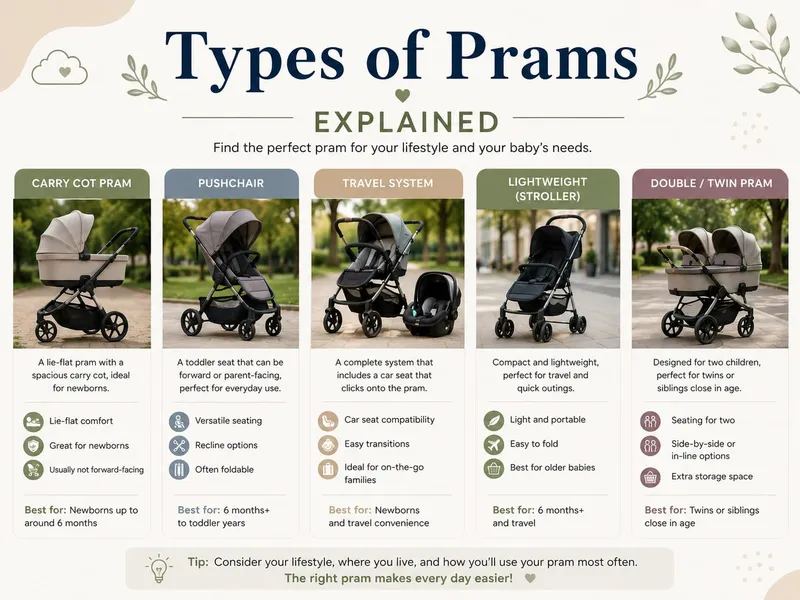
Which pram style suits your life: types explained in practical terms
Traditional prams and carrycots — best for newborn sleep
These give a full flat lie and big, cosy hoods. Choose if your baby sleeps in the pushchair a lot or you walk long routes. Trade-offs: heavy, bulky and slower to fold. Tip: test the carrycot depth at John Lewis or a specialist boutique to make sure it fits through your house door.
Travel systems — car-friendly, grab-and-go
A travel system pairs a pushchair with a car seat (often i-Size). Ideal if you’re in and out of the car a lot or use taxis and trains.
How to choose: confirm car-seat click-fit matches your car and that the folded pushchair fits your boot — take a tape measure to the showroom or use the retailer’s boot-fit tool online.
Lightweight umbrella pushchairs — short trips & holidays
These are featherlight, fold small and live in trunks or under train seats. Great for quick supermarket runs or holidays. Trade-offs: limited suspension, smaller hoods and storage — not ideal for long country walks or newborns without car-seat adaptors.
All-terrain and jogging pushchairs — active families
Big wheels, sturdy suspension and locks for uneven ground. Use these for park trails, beaches or countryside rambles. They’re heavier and take more boot space; check if your daily route has narrow pavements or cobbles where manoeuvrability matters.
Double, tandem and side-by-side prams — siblings sorted
Choose tandem if you need a narrower pushchair for pavements; side-by-side is easier for two older toddlers. Consider doorway width, bus access and whether both seats recline.
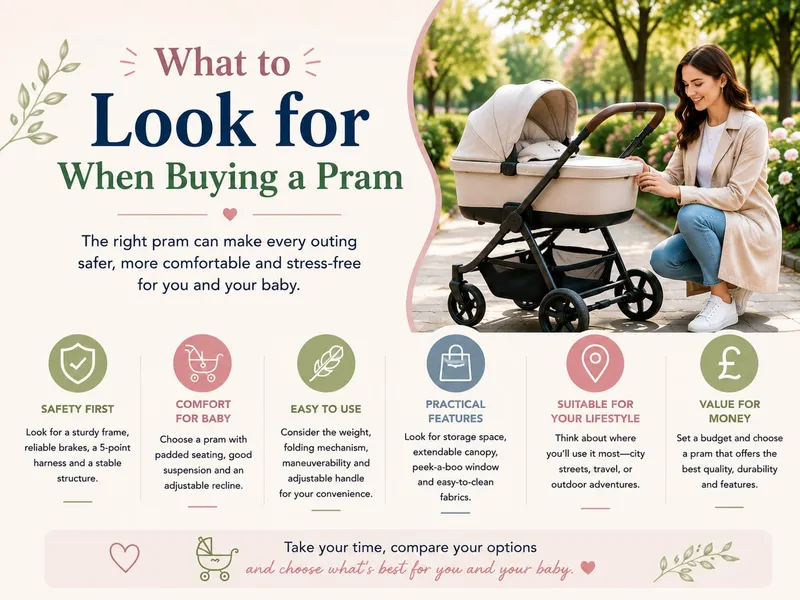
Important practical checklist before buying:
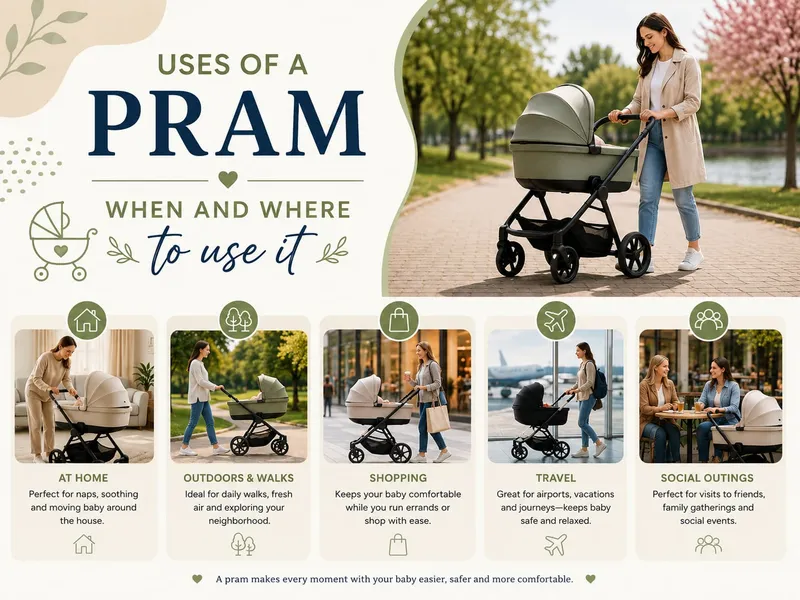
Next, we’ll look at real UK scenarios — where and how you’ll actually use the pram around towns, suburbs and the countryside.
Where and how you’ll use a pram around the UK — practical scenarios
Urban commuting: buses, Tube and last-mile
If you travel by London bus or local low-floor services, you’ll usually fold or stand the pram in the designated space. On the Tube, step-free stations are limited — plan routes with lifts (TfL journey planner helps). For Santander cycles or cycling commutes, a full-size pram won’t come with you; compact pushchairs or a bike trailer are better options.
Rural life: farms, fields and muddy paths
Country walks expose fabrics and wheels to mud, gravel and grass. Choose larger, lockable wheels and easy-clean fabrics. Bring a waterproof footmuff and quick-dry carrycot liner; you’ll thank yourself after a wet half-term walk.
Shopping trips: aisles, boots and parking
Supermarket aisles can be narrow; a two-handed swivel that locks will make threading between trolleys easier. Before buying, measure your boot:
Travel: trains, ferries and planes
On trains you can usually fold and store a compact pushchair in the luggage rack or aisle; during peak times try a fold that fits under a seat. Ferries (P&O, DFDS) allow prams but boarding ramps and doors vary — keep a strap for quick carry. For flights, most UK airlines allow gate-checking; lightweight umbrella folds are often carried to the gate.
Stairs, cobbles and Victorian terraces
Tight staircases need one-handed folding and a shoulder strap for carrying. On cobbled high streets choose big wheels and strong suspension; practice a one-person lift from the pram’s folded handle so you can manage doorstep steps or a narrow Victorian hallway without help.
Accessibility, ergonomics and who might need special features
Who this is for
Not everyone is the same height, strength or mobility. If you’re an older parent, have a long-term condition, or routinely care for children while managing your own mobility needs, look for prams designed to minimise lifting, bending and grip strain. Practical features make daily life easier and safer.
Key features to prioritise
How to test a pram in-store
Try these quick checks before you buy:

Models and real-world tips
Compact models popular in the UK for carers with limited strength include the Babyzen YOYO2, Mountain Buggy Nano and Silver Cross Jet — all praised for lightness and simple folds. Parent-facing or reversible seats can be heavier to operate; if step-free access is rare where you live, favour forward-facing, lighter options.
Public realm & transport
Think about local pavements, kerb cuts and station access: a pram that locks in a stable mode and folds small enough for a bus bay or train luggage area will save daily headaches and keep you moving. Next, we’ll look at where to buy, borrow or hire these options across the UK.
Where to buy, borrow or hire: UK places and smart saving tips
Buy new: high-street and online shops
If you want brand-new warranty and easy returns, try John Lewis & Partners, Argos, Boots, Very and specialist baby shops such as Mothercare (online specialists), Joie and Silver Cross retailers. Department stores often offer price-match or extended returns — useful if you’re comparing test-drives in-store.
Buy second‑hand: where to look and what to ask
Popular UK sources: eBay, Gumtree, Facebook Marketplace, Preloved and NCT Nearly New Sales. Before you meet, ask the seller:
On inspection, check for:
A well-serviced second‑hand Silver Cross or Bugaboo can beat a new budget model for durability and resale value.
Hire or borrow for short trips
If you only need a pram for a holiday, hire from local baby-hire companies in the UK or airport services; some NHS Trusts and children’s centres run loan schemes. Borrow through NCT Nearly New swaps or local parenting groups — handy for trying styles before you buy.

Smart saving tips & checks
Quick real-world tip: a neighbour found a pristine nearly-new chassis at an NCT sale for £120 — serviced it for £30 and saved £300 versus a low-end new model.
Safety, maintenance and legal considerations for UK users
Keeping your child safe and your pram roadworthy is as important as choosing the right model. Below are the practical, UK‑specific things you must know and do.
Age, weight and carrycot vs pushchair limits
Manufacturers label each carrycot and seat with age and weight limits — typical carrycots suit newborns until around 4–6 months (or ~8–9 kg) and many pushchair seats accept children up to 15–22 kg. Always check the sticker or manual for the exact figure; if your baby can sit up, pivot or push up on their hands, switch out of the carrycot even if the weight limit isn’t reached.
Harnesses, brakes and parking on slopes
A five‑point harness is the standard for safety — shoulder, waist and between‑the‑legs straps keep a wriggly child secure. Use the harness every time.
Important quick tips:
Standards, car seats and recall registration
Check for compliance with BS EN 1888 (prams/pushchairs) and check car seats for i‑Size (UN R129) or R44 approval. For travel systems, fit the infant car seat exactly per the manual (rear‑facing is safer for longer; ISOFIX bases reduce installation errors). Register your pram and car seat with the manufacturer so you get recall alerts.
Cleaning, upkeep and winter care
Supervision, public transport and local help
Never leave a child unattended in a pram. On buses and trains fold or move your pram when staff ask — TfL rules vary by service. Avoid blocking pavements or communal entrances (fire safety/legal issues). For local, practical advice contact NCT, Trading Standards, RoSPA or Which? and check gov.uk for recall notices.
Transitioning from safety and upkeep, next you’ll pull everything together to choose the right pram for your life.
Making the right pram choice for your life
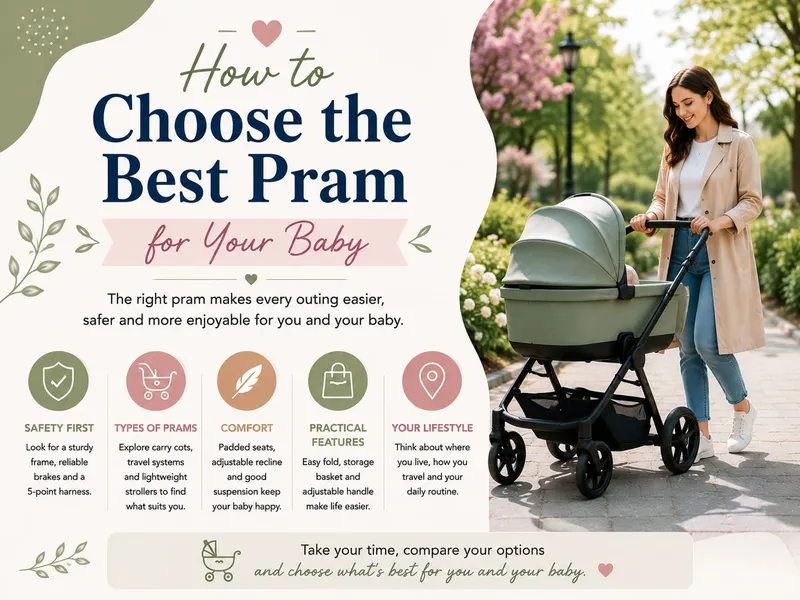
Match a pram to your daily routines, your child’s age and needs, and practical UK factors like bus and Tube travel, car boot size, and flat or stair access. Think about storage at home, local terrain and whether you need one- or two-child capability.
Try models in-store at John Lewis, Mothercare or local independents, and compare good-condition second‑hand options on Facebook Marketplace or pre-loved boutiques. Prioritise safety features (five-point harness, brakes, compliance labels), ergonomics and ease of use. The right pram should make life easier—test it, compare, then buy with confidence now.
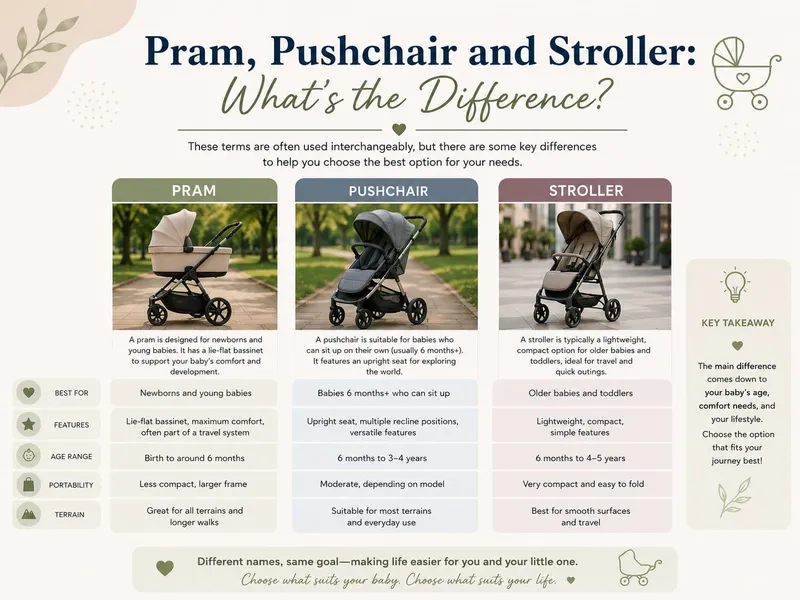

Not super excited by pushchair colours but big fan of safety bits mentioned — reflectors, brakes that lock properly, and checking recall lists. The safety/maintenance section should be required reading for new parents.
Appreciate that — we wanted to make safety feel practical, not scary. Checking the manufacturer’s recall page and routine maintenance (tyre pressure/fastener checks) can prevent common issues.
This guide saved me hours. I was agonising over the Tavira travel system vs a 3-in-1 all-terrain. A few notes from my experience:
– Tavira (with SnugLite) is brilliant for newborn comfort and car seat compatibility.
– 3-in-1 all-terrain was heavier but perfect for muddy countryside walks.
– If you do both city and countryside, think about a second-hand all-terrain for weekends.
Also, the section on where to borrow/hire is gold — we hired a pram for a holiday and realised we didn’t need to buy the heavy model permanently.
Can confirm baby banks sometimes have emergency pram loans. Worth checking!
James — we used a local baby equipment hire place near the coast (they posted it to our holiday address). Also check community Facebook groups and baby banks — sometimes they do short-term loans.
What sites in the UK did you use to hire? I’ve only found a couple local shops near me.
Thanks for the practical tips, Hannah — the hire/borrow approach is something we encourage for parents who have seasonal needs.
Totally this! We keep a lighter travel stroller for city days and hire an all-terrain for hikes. Saves space and cash.
Has anyone compared the Graco Tavira Travel System and the Graco EZLite for frequent flights? I saw the Tavira includes the SnugLite i-Size but worried about gate-check size/handling. 😬
Also check cabin restrictions — some budget airlines have weird rules. Always measure your folded dimensions before booking flights.
Tip: some airlines let you use a car seat up to the gate for your child; if you have the SnugLite i-Size that’s a bonus for newborns.
I flew with the EZLite — super light and easy to check at the gate. Tavira is bulkier but the car-seat compatibility is handy if you plan to drive from the airport.
We used a car-compatible system on holiday once and regretted lugging it on cobbles. Gate-check EZLite next time for sure.
Good point, Zoe. For flying, many parents choose the EZLite-style lightweight travel strollers for gate convenience, and use a car-compatible travel system like Tavira only if they need to drive immediately on arrival.
Ok long post incoming because I wish I’d had all this info before twin babies arrived 🤦♂️
– We got the Graco Stadium Duo tandem double pushchair because it said car-compatible. It’s been a mixed bag.
– Great for car travel and airport runs, but a pain on narrow pavements and in cafés.
– The article’s practical scenarios nailed it: tight city life vs park strolls are totally different. If anyone else has twins and lives in a flat, please chime in — thinking of swapping to an all-terrain 3-in-1 Buggy but worried about losing car compatibility.
Wish the guide had a quick checklist for flat-living parents of multiples.
Great feedback, Raj — thanks for the detailed experience. We’ll add a short ‘flat-living multiples’ checklist in the next update: storage footprint, fold direction (does it fold tall or flat), and doorway width are top priorities.
We moved from a tandem to a more compact double (two seats side-by-side) — saved space in our hallway but lost some car compatibility. If tight indoor storage is the issue, check fold dimensions carefully.
I have mixed feelings: the product mentions felt a bit like a shopping list rather than experiences. Would love more side-by-side comparisons (e.g., Babylo Nuvo vs Graco EZLite) with pros/cons for real UK conditions — like cobbles, narrow High Streets, and boot space.
Completely agree — comparisons would be great. Even user-submitted mini reviews could help future readers.
The boot-size comparisons are the most useful for me. I drive a small hatchback so that’s make-or-break.
Thanks, Claire — that’s fair. The article aimed to list popular models but I’ll add a comparison table focusing on real-world UK scenarios (cobbles, boot sizes, public transport). Appreciate the suggestion.
Short and sweet: Babylo Nuvo One-Hand Fold is a game changer. One-handed folding actually works when you’re holding a wriggly baby. 😅 Fits in my small boot no problem.
Priya — mine came with a basic cover, but I bought a third-party one that fits better. Check compatibility before buying though.
Agreed! I was sceptical then bought the Nuvo for my partner and now we both love it. Quick tip: practice folding/unfolding a few times at home before you need it in public 😂
Does the Nuvo have good rain cover options? We had issues with access to covered playgroups last winter.
Thanks for the quick review, Sophie — we mentioned the Nuvo in the foldability section for that exact reason. Good to hear it performs in real life.
I appreciated the accessibility/ergonomics section. As someone recovering from a wrist injury, adjustable handle height is crucial. The Gcarebb adjustable handle caught my eye. Anyone tested the grip/support on longer walks?
I loved the section on legal considerations in the UK. Quick question: are there UK-wide rules for prams on trains or is it up to individual train companies? The guide hints but I’d like a straight answer.
In my experience: quiet trains = leave it unfolded in designated space; peak times = fold. Always be ready to move if staff ask.
Good question — there aren’t strict UK-wide legal rules mandating pram behaviour on trains; it’s more operator-led. Most train companies ask you to fold during busy times and use designated areas when available. We’ll add a short FAQ summarising typical policies by major operators.
Anyone tried the Gcarebb 3-in-1 with the adjustable handle? Thinking of getting it because of the price, but worried about longevity. The article’s maintenance tips are helpful but I want real-world durability takes.
Durability varies a lot. For budget 3-in-1s, check whether spare parts are available in the UK and read UK-based warranty/review threads. That often predicts long-term support.
We had a similar budget 3-in-1 and it lasted two seasons of heavy use. Good for the price but not as durable as pricier brands. If you plan multiple children, maybe invest more now.
I laughed out loud at the bit about pram ergonomics and parent back strain. 😂 Invest in an adjustable-handle model if you don’t want to turn your daily walk into physio sessions. Also, test brakes — don’t trust online pics.
Solid advice. Ergonomics are often overlooked in favour of looks. We’ll push the handle height and grip checks higher up in the next version.
Yes! Bought a model with fixed low handle before and my partner (6ft) hated it. Adjustable handle was the second-best feature after the fold.
Anyone got suggestions for compact prams that still have good brakes? My local pavements are sloped.
Random tip: if you live near a university or big employer, check community noticeboards for secondhand prams — parents often sell barely-used travel systems. Saved us a fortune on a Maxi-Cosi Lara2. 🙂
Yes! Picked up a Graco EZLite from a parent leaving the city — like-new and half price. Always ask for receipts and service history.
Love this — community swaps and local selling groups are underrated. We linked to some UK-specific platforms in the ‘Where to buy/borrow’ section but will add your tip about noticeboards.
Really useful breakdown — I’m torn between the Graco EZLite and the Maxi-Cosi Lara2 for weekend city runs. Love that the article covers compact folds and lie-flat options. Anyone using the Lara2 on buses in London? Wondering about boarding with a buggy and a toddler in tow.
Good question, Emma — many UK parents say the Lara2 is bus-friendly because it’s compact, but with a toddler you’ll still need to fold or keep them on your lap depending on the route. If you often use buses, the EZLite’s lightweight fold can be easier for quick stows.
I have the Lara2 — it fits on most buses but I still fold it at busy stops. If you need lie-flat for naps on the go, Lara2 wins. If you prioritise super-light weight, go Graco.
Pro tip: try both in-store with your usual travel bag. The article’s section on where to buy/hire in the UK helped me test models before buying.